Tuesday, February 11, 2014

THE VODU (AFRICAN GODS)

THE VODU (AFRICAN GODS)

Official Names: Vodu
Nicknames: African Gods, Gods of Africa, Voodoo Gods, Gods of Voodoo, Dahomey Gods, Yoruba gods, Fon gods, Ewe Gods, "Black Gods," et al
Former Aliases: None
Other Current Aliases: Orishas, Loa
First Appearance: (glimpse) Thor #301, (actual) Doctor Strange III #17/Firestorm #95

Gods of Africa

  Talk0
Information-silk
The Gods of Africa

Obatala
Information-silkName
The Gods of Africa
Information-silkAliases
Orishas, The Loa, African Gods, The Black Gods
Information-silkBase Of Operations
Ife
Information-silkBody Type
Humanoid
Information-silkNumber of Limbs
4
Information-silkNumber of Fingers
5
Information-silkNumber of Toes
5
Origin
Information-silkStar System Of Origin
Sol
Information-silkHome Planet
First appearance

History

The Gods of Africa are an extra-dimensional race of beings who worshipped as gods by the tribes of Africa and were known as the "Orishas" (gods) to their African worshippers and as the "Loa" (spirits) by practitioners of Voodoo.

Powers and Abilities

Powers

None known.

Abilities

None known.

Average Strength level

Unknown.

Weaknesses

None known.

Habitat

Habitat: Habitat of this race is unknown.
Gravity: Gravity of this race is unknown.
Atmosphere: Atmosphere of this race is unknown.
Population: Population of this race is unknown.

Miscellaneous

Type of Government: Tribal
Level of Technology: Magic
Cultural Traits: The Gods of Africa share the same characteristics as their African worshippers.
Representatives:

See Also


Links and References

Start a DiscussionDiscussions about Gods of Africa

 You can find discussions about everything related to this wik

History

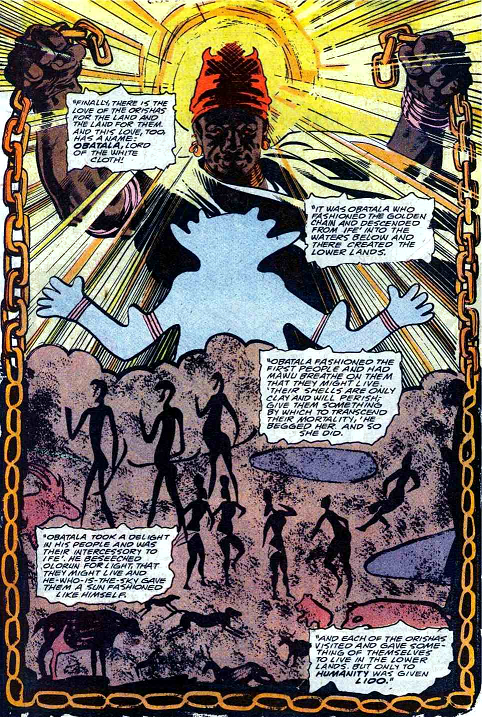
  "Orisha" is the Yoriba word for "god". The Orishas, or the Black Gods as they are also known, are all said to aspects of Ifé (the living land, Earth, or more specifically Africa) and personifications of abstract concepts. Shango is the living thunder, while Olorun is the sky, Oshunmare is the rainbow, and Orunmilla is the law. As legend has it, the mother of all the land and its black gods is Mawu.

==Origin==

Dimension of Origin: Ife (Afe)
Habitat: Tropical
Gravity: Earth-like
Atmosphere: Earth-like
Population: 500-800 (estimated)
Other Associated Dimensions: The Vodu preside in the other-dimensional land of Ife, also known as Afe, possibly having relocated there at some point in the Earth's past. Resembling a realm similar to but not identical to Asgard or Olympus, it is also linked to the other-dimensional realm of Iku, the realm of the dead, governed or controlled by Damballah, one of the Loa. The realm of the African gods is also filled with other beings such as dragons, demons subservient to the gods and a race of beings similar to but not identical to the elves of Alfheim and Momur.

==History==
The Vodu or Gods of Africa are a race of superhumanly powerful humanoid beings worshipped by the native indigenous aborigine tribes of inland Africa. Worship of the Vodu possibly began around 2900 BC when the ancient Afrikaans first began showing signs of civilization. Unlike the majority of Earth's pantheons of gods, they are still worshipped today, but they are not nearly as active as they were in ancient times. The Vodu dwell in Ife (also called Afe or Ala), a small "pocket" dimension adjacent to Earth; an interdimensional nexus between Ife and Earth exists somewhere near Mount Kilimanjaro in modern Tanzania, considered a mystical location among its neighboring tribes. (Ife was also the name of the sacred lands of the Yoruba.) The human worshippers of the Vodu often had separate names for their gods that varied by tribe and region; for example, the Yoruba of Benin called the ancestor of the gods Buluku, whereas the tribes of Mozambique called him Muluku.

The precise origin of the Vodu, like that of all of Earth's pantheons of gods, is shrouded in legend. It is unknown if they originated on Earth or from some other dimension. The earliest known African god was Buluku (or Bouclou), known as Olorun to the Yoruba, who took the earth-goddess, Nana, as his wife. It is believed that Nana was actually Gaea, the primordial earth-mother who had survived the destruction of the Elder Gods of Earth by infusing her life into the life-giving essence of the Earth. Many of the Elder Gods had degenerated into demonic status and were destroyed by Atum or had fled Earth for other planes of existence. Atum had been born from Gaea by mating with the sentient biosphere of the Earth known as the Demiurge. Atum later departed the earth after shedding the excess demonic energies of the Elder Gods he had slain; some of these energies becoming demonic beings like Mephisto, Satannish, Sutur and possibly Mikaboshi, who became the eternal enemy of the Japanese gods. Whether Buluku was another form of the Demiurge or of Atum himself is unrevealed.

According to the ancient myths, Buluku mated with Nana and sired the first generation of the African gods known as the Orishas, who then became the ancestors of the later African gods. As a result, the tribes of Africa have never had a truly defined pantheon. Separate aborigine tribes respected separate deities, all of whom descended in some way from Buluku who was known by several names. Several deities, like Shango the thunder-god and Damballah, the god of the dead, were respected and honored by several different tribes. The gods of West Africa worshipped by the Dahomey, Fon and Yoruba tribes, became the most recognizable deities to European and Asian invaders, who sometimes brought their own gods and religious beliefs with them. At some point, Buluku departed from Earth or decided to retreat from human affairs and named Nyambe, one of the Orishas, as his successor over the African gods.
By now, the Third Host of the Celestials occurred and Nyambe was approached by Odin, Chieftain of the Asgardian gods, to meet with the rulers of the other gods once worshipped on Earth to discuss the threat of the Third Host of the Celestials. The Celestials had threatened to seal off the portals of each of their godly realms unless they promised to stop interfering in mortal affairs. Nyambe swore to this pledge and even made a vow to Odin to donate the necessary life energies to the Asgardians slain during the Fourth Host of the Celestials. When Thor came to Ifa to petition a portion of the required life energies as part of this vow, Nyambe saw that a debt had been paid to his realm and offered Thor the necessary energies to restore the slain Asgardian gods to life.
With European exploration of Africa, several Afrikaans, particularly the Yoruba and Dahomey, were taken as slaves in other lands, such as Rome, Egypt and the West Indies. The captured Afrikaans called upon their gods for solace, but due to their pact with the Celestials, they were unable to intervene on behalf of their worshippers. Furthermore, Sagbata, the god of death and misfortune, made a pact with Chthon, one of the exiled Elder Gods, for a spell to create legions of undead beings from the dead or "zombies." Legba, the son of one of the Orishas, petitioned among his siblings to create a force of good against the evil of Sagbata, thus creating the religion now known as Vodu, combining elements from Catholicism and the Holy Roman Church. The chief gods in the Voodoo religion became known as the Loa. Beliefs and tents in Voodoo subsequently spread through the West Indies, Southern United States and the Pacific rim of South America where their practitioners, both Afrikaan and European in origin, clashed with the native gods of those regions, notably the Mexican and Incan gods. One of the most powerful Voodoo priestesses in history was Marie LaVeau.
In modern years, a few of the African gods have made efforts to reconnect with humanity or with the foreign gods of other pantheons. Shango teamed up with Thor and several warrior-gods to battle the Demogorge, released by several under-world gods, and even lived among mortals for a short time, becoming allies with the costumed hero, Firestorm. Nyambe and the Council Elite (sometimes referred to as Council of God-Kings) came together to discuss the threat of Thanos, one of the Eternals, and judge Thor's worthiness to join their council after the death of Odin. Nyambe also met with the council to examine the threat Akhenaton posed to the gods of Earth, but he did so under the guide of Ndriananadhary, the Malagasy god of the afterlife.
Much like the Olympian and Asgardian gods, the Vodu are represented on Earth by a number of costumed adventurers paying tribute to their legacy. Brother Voodoo is the chosen representative of the Loa while Vixen of the Justice League of America utilizes a mystical talisman passed down through her ancestors from Anansi, the spider-god, who also extends his protection over Spider-Man. The Santerians, a Hell's Kitchen vigilante group, also pay tribute to their memory.
Relations with Other Pantheons: The disputes the Vodu have had with the Coatli and the Incan Gods have already been documented, but Nyambe has had greater exposure with the gods of other pantheons through the Council Elite. The connections with the Gods of Egypt are undefined; some Egyptian gods, notably Mihos, were sometimes imbued with African characteristics.
==Characteristics== 
Body Type: Humanoid
Avg. Height: 6' 0"
Eyes: Two
Hair: Normal
Skin: Normal
Limbs: Two
Fingers: Five with opposable thumb
Toes: Five
Special AdaptationsThe African gods are exceptionally long-lived, but they are not immortal like the Olympian gods; they age very slowly upon reaching adulthood, but they are not invulnerable to death. They are physically more durable than human beings; their skin, bone and tissue being three times more durable and dense than similar tissue in human beings.

==Powers== 
Avg. Strength LevelAll African gods are superhumanly strong with the average male being able to lift (press) about 30 tons under optimal conditions and the average female being able to lift (press) about 25 tons under optimal conditions. 
Known PowersThe African gods possess superhuman strength, stamina , longevity and resistance to harm. They are also inclined to tap and manipulate mystical energies for feats of magic, mostly for altering their appearance, communicating over long distances, teleporting through dimension barriers and casting spells. The scope of their powers mostly limited to one object, idea or field, usually tied into their personality. For example, as the African god of thunder, Shango, has dominance over the powers of storm and weather, whereas, Sagbata, the African death-god taps into powers of the underworld, such as curses and misfortune upon mortal man. 
Known Abilities: The African gods are tribal in nature and are excellent hunters, warriors and trackers, much more adept in spears and poison darts than in swords and archery. 

==Miscellaneous== 
Type of Government: Tribal
Level Of Technology: Magic
Cultural Traits: The African Gods were worshipped as gods in throughout the African continent and Madagascar, later spreading to the Southern Continental United States, West Indies, Gulf Coast and the Eastern rim of South America. Most of their cultural patterns reflect those of their worshippers, possibly due to living with their worshippers on Earth in ancient times before they departed Earth.
Names of RepresentativesAnanseAvleketeAyabaDamballahErzulieEschuFaaGouLegbaLoco, Lusa, Maou, Mawu, NanaNdriananaharyNyambeOgun, Olokun, Orishako, SagbataShangoZaca, et al.
==Trivia==
  • "Orisha" is the Yoruba word for "god." "Loa" is the Yoruba god for "spirit."
  • In African Myth, Afe (Ale, Afe, Ife, Ile, Ila...) are names of the ancestral land of the Yoruba-Dahomey people. Here, the names are used to identify the home of the African gods and the home of their worshippers.
  • Mount Kilimanjaro consists of two volcanic peaks about seven miles apart separated by a wide saddle. Kibo, the higher peak, rises to 19,340 feet while the summit of Mawensi is 16,892 feet above sea level. The top was the scene of "The Lost World" by Sir Alfred Conan Doyle. Doyle's novel could have been based on legends of large pterodactyl-like creatures seen swooping down from the top.
==References==
  • African Mythology A-Z by Patricia Ann Lynch
  • Dictionary of Ancient Deities by Patricia Turner and Charles Coulter
  • Encyclopedia of Gods by Michael Jordan
  • Mythologies of the World by Rhoda Hendricks and Mike Shapiro
  • Native American Myth & Legend by Mike Dixon Kennedy
==External Links==


OURANUS

OURANUS
Real Name: Ouranus (possibly)
Occupation: Sky-Father
Legal Status: Citizen of Olympus
IdentityThe general populace of Earth is unaware of the existence of Ouranus except as a mythological deity.
Other Aliases: Father-Sky, Atum-Re (Egyptian name), Buluku (Dahomey name), Buri (Norse name), Gitche Manitou (Algonquin name), Hunab-Ku (Mayan name), Inn (Japanese name), Jumala (Finno-Ugrian name), Nuadhu (possible Celtic name), Ometeol (Aztec name), Papa (Polynesian name), Prajapati (Brahmanic name), Purusha (Hindu name), Rod (Slavic name), Tecumotzin (Incan name), Tirawa (Navaho name), Tornarssuk (Inuit name), Uranus (Roman name), Vatea (Maori name), Yin (Chinese Name), et al
Place of Birth: Unknown, possibly inapplicable
Place of Death: Mount Olympus, Thessaly (now part of modern Greece)
Marital Status: Single
Known Relatives: Atum (possible father), Gaea (alleged mother), Cronus, Varuna (sons), Rhea (daughter), Zeus (grandson),
Group Affiliations: Ancestral Father of the Gods of Earth, possible ally to the Council Elite
Base of Operations: Olympus
First Appearance: (name) Official Handbook of the Marvel Universe Deluxe #8, (physical) Journey into Mystery #97
History: Virtually nothing is known about the origins of Uranus, beyond the fact that he is considered the paternal ancestor or sky-father of all the major pantheons of gods of earth. According to accounts, the Elder Gods were the first sentient beings to exist on earth after coalescing out of the Demiurge or sentient biosphere of the planet. Since there were no other beings on Earth, the Elder Gods eventually degenerated into demons; in other words, they became parasitic beings by feeding on the life energies of other beings to survive. Since humankind had not yet been born, these Elder gods began preying upon their own kind in order to exist. Fearing their battles would destroy newly evolving life on Earth, Gaea called upon the Demiurge and mated with it, siring Atum, the first of a genetically perfect breed of immortals. Atum slew the majority of the Elder Gods who had degenerated into demons, but Gaea was allowed to exist because she had passively and non-violently linked her godly life essence into all living things on earth. Atum later sired with Gaea the Ogdoad, the ancestors of the later Ennead or collective deities of Egypt, considered among the oldest gods of Earth.
According to later Greek and Roman myths, Uranus was sired by Gaea and she later accepted him as a mate, but whether Uranus and Atum are one and the same being is unrevealed. Atum and Uranus have tenuous connections as progeny of Gaea, but it is not known if they are one and the same, especially considering that Atum has been active well into recent times, unlike Ouranus. It is known that the Demiurge later split into a variety of beings, and that Uranus could be one of these beings. Several beings have identified themselves as the undisputed paternal ancestor of the earth's gods, but whether or not they are all one being or a variety of equal beings is unrevealed.
Many of these primal figures share common facts and histories with Ouranus, either willingly stepping down to a position of power to retire his earthly power, such as when Ammon-Ra succeeded Atum-Re, or were ousted from power by figures like Cronus who deposed Ouranus. Several millennia ago, Ouranus and Gaea sired the Titans, the first generation of the Olympian gods. Ouranus was greatly pleased by the Titans for their genetic purity, endowing them with appearance, power and prestige, but he was displeased by his other progeny for being less than perfect. He exiled the Hecatocheiroi and the Cyclopes to the other-dimensional realm of Tartarus to conceal them from view from mortal man, and Gaea petitioned from among the Titans someone to depose Ouranus. The majority of the Titans refrained from the pact except for Cronus who took a scythe and slew Ouranus from power, later taking over leadership of the Titans. The dying Ouranus had prophesized that Cronus would be overthrown by one of his own children, and Gaea helped his wife, Rhea, conceal the birth of his son, Zeus, for him. When Cronus failed to live up to his promise to release his exiled brethren, Gaea raised Zeus in secret and he freed his captive relatives to storm the heavens and oust Cronus from power. 
According to Polynesian myth, Tame, the son of Papa and Gaea in her role as Rangi, the Polynesian earth-goddess, also drove his father from power through the use of an axe. Whether or not the Polynesians and other cultures are telling alternate versions of the same incident described the the Greek and Roman people is unrevealed. Several of the primal sky-fathers have not been seen on earth since being removed from earth, but whether or not they are all the same being as Ouranus or of the same progeny is unrevealed.   
It is known that Gaea might have mated with a number of other beings to give birth to the respective pantheons of earth. As Tiamat, the great ocean-goddess, she mated with Apsu, the freshwater god to sire the Igigi, ancestors of the later Anunnaki or Mesopotamian gods. (The Greeks, however, named this deity Pontus, father of the sea-gods, Nereus, Proteus, Phorcys and Ceto.) She also mated with Tartarus, the being that shares his name with the underworld, to sire Typhon, to be the eternal nemesis of the Olympian gods. It is uncertain whether Ouranus could possibly be the figure named Nuadhu who fathered the Fomore, the ancestral spirits of Eire (modern Ireland). Later mythology confuses this figure with another Nuadhu, the half-mortal son of the Dagda, who became leader of the Celtic gods. This later Nuadhu later resurfaced in modern years seeking a number of objects to grant him power, but he was defeated by the Young Gods.
Around 1000 BC, a mysterious being known as Buri migrated north into the region of Niffleheim and sired the Asgardian race from an unknown daughter of Ymir, the frost-giant. Buri turned up years later living an isolated existence in the out-skirts of Asgard. Whether this being was actually Ouranus having returned to life is unknown. 
In recent years, a figure claiming to be Hunab-Ku, the ancestor of the Aztec and Mayan gods attended the Council of Godheads to address the threat of Akhenaton to the cosmos. Whether this was Ouranus in one of his roles or the true Hunab-Ku is unrevealed.

Height: 10' 0"
Weight: Undetermined
Eyes: Blue
Hair: White

Strength Level: Ouranus possibly possesses Class 100 level strength, enabling him to lift (press) well over a hundred tons under optimal conditions.

Known Superhuman Powers: Ouranus possesses the conventional physical attributes of the Immortals, the collective race of beings known as the Gods of Earth. Like all Immortals, he is immortal: he has not aged since reaching adulthood and cannot die by any conventional means. He is immune to all Earthly diseases and is resistant to conventional injury. If he were somehow wounded, his godly life force would enable him to recover with superhuman speed. It would take an injury of such magnitude that it dispersed a major portion of his bodily molecules to cause him a physical death. Even then, it might be possible for several gods of significant power, such as ZeusOdinAnu or Vishnu working together to revive him. Ouranus also possesses superhuman strength and his Immortal metabolism provides him with far greater than human endurance in all physical activities. (Immortal flesh and bone is about three times as dense as similar human tissue, contributing to their superhuman strength and weight.)

Ouranus has incredible mystical prowess above that of any known god or goddess on earth. His mastery of the mystical arts is far above the levels of deities such as Odin and Zeus. He can bestow power on mortal sorcerers and mystic who know how to call upon him. Ouranus is possibly on par with such cosmic beings such as Eternity, Galactus and the Elders of the Universe.

Comments: In Polynesian myth, Papa is the maternal goddess and Rangi the paternal god; however, in Marvel Comics, the roles are reversed.

Clarifications: Ouranus is not to be confused with:  

  • Atum the God-Slayer, primeval deity of earth, @ Thor Annual 12
  • Nuadhu, Celtic Chieftain, son of the Dagda, @ Marvel Comics Presents #105
Last updated: 10/05/07

MITRA

MITRA
Real Name: Mithras (original spelling)
Occupation: God of Wisdom, Light and Prosperity
Legal Status: Citizen of Nirvana
Identity: The general populace of Earth is unaware of the existence of Mitra except as a mythological deity.
Other Aliases: Mithra (alternate spelling), Mayin (Altaic name), Lord of Light
Place of Birth: Unknown
Marital Status: Married
Known Relatives: Purusha (father), Gaea (mother, alias Aditi), Varuna (brother), Dyaus (nephew), Vishnu, Brahma, Shiva (half-brothers), Savitri (sister/wife), Pushan (son), Ganehsa, Skanda, Adharma, Kama, Indra, Tvashtri, Surya, Agni (great-nephews), Kali, Vach, Ushas, Ratri (great-nieces)
Group Affiliation: The Adityas and the Yazatas (Persian Gods)
Base of Operations: Elysium
First Appearance: (historical) Weird Tales XXI #6, (recent) Savage Sword of Conan #2
History: Mitra is one of the oldest gods of the earth. Born the son of Gaea in her role as Aditi, the Vedic mother-earth, he was worshipped as a god during the Hyborian age by inhabitants of Aquilonia, Argos, Ophir, Nemedia and Zingara, rivaled only by malevolent deities such as Set from whom many of his worshippers sought Mitra’s protection. To mortal man, Mitra ruled a gentle afterlife of saints and angels and preached mercy above vengeance. He also served as mankind’s eternal judge and granted final rewards to the pious in heaven and sending sinners to punishment in the underworld. Even in kingdoms that did not worship Mitra, his name was often invoked as a sign of respect.
Xaltotun, a native of the long-lost kingdom of Acheron, promoted worship of Mitra.  Epemetrius the sage supported the Mitran religion, and one of the earlier nations to embrace Mitra was Koth, although they later abandoned worship of Mitra to embrace the Semite culture of Ishtar. At some point, Mitra cursed a decadent city, and in time, this city became a home for many supernatural monsters. A Mitran solar rune was placed on a rock to control the monsters, but it was later corrupted.
At some point, Mitra banished the demon Molub, who had ruled a domain on Earth, to the netherworld. However, a cursed ring could return Molub to Earth, to slay whoever was given the ring. Many people over the years had the ring unknowingly passed to them by their enemies.
In the city of Eidoran, once a mighty but now a decadent place, Set worshippers summoned forth demons such as Khorus from an infernal dimension. The first followers of Mitra hired their own sorcerer-who used a crystal skull to focus his powers and bind the demons in stone. After this, the Mitran clergy guarded the ruins of Eidoran.
According to one account, Mitra acting in tandem with other gods of light had chose the legendary warrior-king Conan the Barbarian as their champion against the forces of dark gods such as Set. Conan indeed battled many enemies and dark forces against Mitra such as a Mitraic priestess named C'Harona seduced by Set with promises of power. Mitra called for an instrument of retribution, and the dark-god, Erlik, answered his called by setting into motion the events which brought into existence the woman-warrior, Red Sonya. She became a contemporary of Conan the Barbarian.
On the borderline of Aquilonia, Conan encountered one of Mitra's archangels and was given the power to confront a priestess of the demon-god Yog. This priestess had gained vast power, which she intended to use to conquer the world for her master. Both Conan and the priestess clashed, and she was killed, but her blood cursed the land upon which it fell, making that land a place of war and disorder. This land would eventually become known as Palestine.
Mitra was one of the few Hyborian gods who continued to gain prominence after another cataclysm reshaped the earth. Now almost completely excluded to the modern areas of India, Pakistan and Iran, he was a prominent member of the Adityas, children of Aditi (the Vedic name of Gaea), and ruled a pantheon of gods with Varuna and the storm-god, Rudra. Mitra worship was honored even as far away as in the Roman Empire, where he replaced Helios as god of the sun. As Mitraic worship came into decline, younger deities such as Vishnu, Brahma and Shiva came into power under Hinduism. Varuna became chief of the Yazatas, or Persian Gods, as Ahura Mazda under Zoroasterism. Mitra also had a role in the Persian religion, but he was nowhere as prominent under Varuna’s dominance as he once was.  Several rites of the Mitraic religion were adopted into the developing Christian religion, particularly the concept of an afterlife of saints and angels and the concept of mercy above vengeance. Even long-devoted Emperor Constantine of Rome, a supporter of the Mitraic religion, converted to Christianity when his Mitraic priests would not cleanse him for the murder of his son in 313 AD. However, Zoroasterism and Mithraism were both wiped out in Persia in 650 AD by the Arabs, and Persia, later Iran, became a Muslim-dominated land.
Mitra’s existence, however, has never completely vanished. He was invoked by one of the followers of Andros recently and his presence was used against the Serpent Men of Starkesboro, known supporters of Set, who still has loyal supporters through his Serpent Crown.
Height: 6'2"
Weight: 310 lbs.
Eyes: Blue
Hair: White (Black in his youth)

Strength Level: Mitra possesses Class 100 level strength and can lift (press) over 100 tons under optimal conditions.

Known Superhuman Powers: Mitra possesses the conventional physical attributes of the Adityas. Like the Adityas, he is immortal: he has not aged since reaching adulthood and cannot die by any conventional means. He is immune to all Earthly diseases and is resistant to conventional injury. If he were somehow wounded, his godly life force would enable him to recover with superhuman speed. It would take an injury of such magnitude that it dispersed a major portion of his bodily molecules to cause him a physical death. Even then, it might be possible for a god of equal and significant power, such as Varuna or Vishnu or for a number of less-powerful gods of equal power working together to revive him. Mitra also possesses superhuman strength and his metabolism provides him with far greater than human endurance in all physical activities. (Adityas flesh and bone is about three times as dense as similar human tissue, contributing to their superhuman strength and weight.)
Mitra also has extra-ordinary mystical power on par with modern gods such as Vishnu, Varuna, Odin and Zeus. He can travel through dimensional barriers and planes of existence, manipulate cosmic energy on near-infinite scales and conjure incredible balls of light. He is highly clairvoyant and can sense the thoughts and memories of both mortals and immortals. He can also see into the past and future. He can extend his life-force into inanimate objects, such as statues of himself or objects of Mitraic origin. This power makes him almost omnipresent and all-knowing. He can bestow power on mystics who know how to call upon him, although even persons without skills in sorcery, such as Conan, could call upon Mitra for power. He can heal the sick and raise the dead to a full semblance of life.
Mitra's full range of powers are unrevealed, but he is quite possibly one of the most powerful gods known in mythology.
Abilities: Mitra is a skillful diplomat and leader, an eloquent speaker and observer. A highly beneficent and merciful deity, he can be quite charismatic.
CLARIFICATIONS: Mitra is not to be confused with:
·         The Mithras Project, religious sect @ Deadpool III #15 

ASMODEUS

Real Name: Aeshma Deus
Occupation: Lord of Hell
Legal Status: Non-Entity
Identity: The general populace of Earth is unaware of the existence of Asmodeus except as a mythological character.
Other Aliases: Abaddon, Azmodeus, Ashmodei, Asmodaios, Ashmedai, Asmodai, Asmodee, Osmodeus, Osmodai, et al.
Marital Status: Married
Known RelativesAhriman (father, alias Ravanna), Ahah Manah, Apaosha, Druj, Saura, Nasu (brothers), Jahi (sister), Vohu ManahArmaiti,HaurvatatAshaAmeretetSharevar (cousins),Lilith (wife), Belial (son),
Group Affiliation: The Spenta Mainyu
Base of Operations: Abaddon
First Appearance: (historical) The Book of Tobit, (modern) The Twilight Zone (Episode: The Other Place); (recent) Ghost Rider II #53
History: Asmodeus is a one of the Asuras, one of a order of underworld gods native to the realms of the Hindu and Persian Gods. However, in Christian theology, he is considered one of several "fallen angels" who joined Lucifer's rebellion against God and was cast out of Heaven like Lucifer's other allies and degenerated into a demon. It is unknown how much of this is correct or if Asmodeus was just one of several demons known on Earth who became allies with Lucifer and were subsequently exiled to the underworld. (In Hebrew theology, Asmodeus is the son of Adam and Naamah, a female demon, but this account may be apocryphal.)
Like all demons, Asmodeus presides in Abaddon, the lowest part of the underworld reserved for the suffering of human souls. Abaddon was known by several names including Sheol to the Hebrew and Apollyon to the Greeks, but in modern Christian theology, Abaddon is known as Hell. In Christian lore, he was one of seven lords of hell under Lucifer, who was identified as Satan in the Bible. Each of these lords represented each of the seven sins with Asmodeus representing lust and carnal desire, therefore responsible for twisting people's sexual desires. According to one account, Asmodeus encountered Lilith, the Mesopotamian underworld-goddess who ruled over Hell, and eventually mated with her, siring the demon, Belial, and several other demonic progeny. Several demons are believed to have ruled and controlled several portions of Hell, creating a very complex hierarchy of demons and lesser demons, often fighting and scheming with each other for complete dominion.
Asmodeus was reportedly greatly attracted to Bathsheba, one of the wives of King Solomon of Judea in the Tenth Century BC. According to ancient legends, Asmodeus was one of several demons mystically imprisoned by King Solomon to help him in the construction of the Temple of Solomon in Jerusalem. He also predicted that Solomon's kingdom would one day be divided, but when Solomon tried to interrogated Asmodeus further, the king learned that the wily demon was prevented from making further predictions by the angel Raphael. Asmodeus later confessed to hating water and birds because both reminded him of God. However, Asmodeus sent King Solomon on a mission that sent him from Canaan then changed places with him to be with Bathsheba for some years. When Solomon returned, Asmodeus fled from his wrath.
In the Eight Century BC, Asmodeus fell in love with Sarah, a woman in Assyria, and slew all of her potential suitors. Sarah's cousin, Tobias, a Hebrew prophet, was advised by Raphael to abstain from sexual relations with her for three nights and showed him the rituals to drive away Asmodeus. Burning the liver and heart of a fish, Tobias managed to drive Asmodeus away, and Asmodeus fled to Egypt where he clashed with Raphael for several battles.
In modern years, Asmodeus often appeared to mortals as a handsome man with a cane often running a gambling parlor or brothel in Purgatory, inciting gambling and over-seeing humans cavorting with humans under his allegiance in order to procure souls. With Lilith by his side, Asmodeus ruled over seventy-two legions of demons under his command, but in recent years, he sought to make a pawn of the Ghost Rider in his intended campaign of terror against the Earth, often sending lesser demons to Earth to try and corrupt Johnny Blaze, the human side of the Ghost Rider. His interest in the Ghost Rider led to some enmity with Mephisto, who held the contract on Blaze's soul. Asmodeus continued to proceed with collecting other human souls, briefly clashing with Dracula, the Lord of Earth's Vampires, over the soul of a mystic named Gregor Smirnoff. He also posed as a human in a game of chance with Belasco, Dormammu and Mephisto over the soul of the succubus Satana but was driven from Earth by a mystic sword wielded by Deadpool.
In recent years, Asmodeus met with the other rival lords of hell over the threat of Cul the Serpent to their perspective realms.

Height: 6' 3"
Weight: 425 lbs.
Eyes: Yellow
Hair: Black

Unusual Physical Features: Asmodeus tends to appear in several forms to mortals. Usually appearing as a fine-dressed gentleman, he has also appeared as a satyr or as a man with a serpent's tail and the heads of a sheep, a bull and a ball of fire.
Strength Level: Unrevealed. Asmodeus possibly has superhuman strength enabling him to lift (press) around 30 tons under optimal conditions.
Known Superhuman Powers: Asmodeus is a Class Two demon possessing analogous physical attributes of the Gods of India. Like the Yazatas and the Devas, the Gods of Persia and India, Asmodeus is extremely long-lived, but he is not immortal like the Gods of Olympus. Using mystical means to preserve her youth, he has ceased to age upon reaching adulthood and cannot die by any conventional means. He is immune to all Earthly diseases and is resistant to conventional injury. If he were somehow wounded, his life force would enable him to recover with superhuman speed. It would take an injury of such magnitude that it dispersed a major portion of his bodily molecules to cause her a physical death. Asmodeus also possesses superhuman strength and endurance; his Rakshasas metabolism provides him with far greater than human endurance in all physical activities.
Asmodeus has several abilities to tap into and manipulate occult energies. He can project blasts of mystic force and conjure psychokinetic energy in the form of poltergeist activity. He can also sense and perceive the thoughts of mortals and lesser demons, but he cannot read the thoughts of other demons. His primary power is the ability to procure the life energies ("souls") of living things, specifically human beings, giving him complete control over his victims or completely reducing them into a desiccated corpse. However, he is not nearly as powerful as demons like Ravanna or Mephisto, who could conjure Asmodeus to his presence against his will.
Pets/Transportation: Asmodeus often rides a lion-headed winged dragon.
Comments: This bio describes Asmodeus as he has appeared in Marvel Comics and in The Twilight Zone (Episode: "A Nice Place To Visit"); it is not known if he has appeared in DC Comics.
Clarifications: Asmodeus is not to be confused with:
  • Asmodeus, Dr. Charles Benton, former leader of the Sons of Satannish, @ Dr. Strange I #169
  • Asmodeus, a green-skinned member of the Inhumans, @ Fantastic Four I#117
  • Asmodeus, devil-worshipper, ally of Morningstar, @ Moon Knight I#29
  • Asmodeus, a, extra-dimensional entity worshipped by the Enclave, @ Tomb of Dracula Magazine #2
  • Asmodeus, former warlock turned demon, member of the Triad, @ Charmed TV-Series (Episode: The Magic Hour")
  • Asmodeus Jones, entertainer, pawn of the Fashima of the Six-Fingered Hand, @ Defenders I #96
  • Azmodeus, bird-demon, servant of Master Pandemonium, @ West Coast Avengers II #4
HIISIReal Name: Lempo
Occupation: God of misfortune, former forest-god
Legal Status: Non-Entity
Identity: The general populace of Earth is unaware of Hiisi except as a mythological character.
Other Aliases: Paha, Paapiru ("Father of the Piru"), Junta, Juntas, Rota, Rutu-Aimo,
Place of Birth: Unrevealed
Marital Status: Single
Known Relatives: Kaleva (alleged father), Aijo (mother), Pohjan, Undutar (aunts), Louhi (alleged grandmother), Paha, Juntas (possible brothers), Suoyatar (sister), Mammalainen (neice), Aarni (grand-niece)
Group AffiliationsThe Gods of Finland
Base of Operations: Pohjola (now part of modern Finland), possibly Mobile
First Appearance: Hiisi has yet to appear in Marvel or DC Comics.
History: Hiisi is a member of an extra-dimensional race of beings known as the Kalevalans, an extra-dimensional race of beings who were worshipped as gods by the Ancient Finno-Ugrian tribes of Eastern Europe. In ancient myths, he was described as a woodland spirit who caused mischief and haunted locations where the Ancient Finns worshipped and sacrificed to their gods. Not much more is known about his origins. In some myths, he is known under the names of Paha and Juntas, but it is not certain if these are actually other names or other gods.
After Christianity was introduced in Finland, Hiisi was actually recognized as having more demon-like attributes and became known as the god of evil among the Ancient Finns. At some point, he took the name Hiisi from the hiisi ("demons'), the evil spirits native to the Kalevalan cosmology of of gods. Hiisi was known to torment mortals, particularly the wizard, Vainamoinen, during his attempts to visit the land of Pohjola. As Vainamoinen was constructing a boat strong enough to visit the frozen north, Hiisi and a number of demons distracted Vainamoinen, and the wizard accidentally pierced his own leg with his axe. Vainamoinen survived by using magic to stave off his wounds. About a year later, Hiisi was one of the beings summoned by Louhi, the Queen of the North, to attack and punish Vainamoinen for stealing the Sampo, but Vainamoinen and his brothers fought off Hiisi and the demons and escaped.
Hiisi's modern whereabouts are unknown. Worship of the Finnish gods declined after Christianity was adopted as a religion in Finland, but later folklore identifies Hiisi as another name of the Christian devil. His later activities are as yet unrevealed, but it is believed he was among the rival lords of hell meeting over the threat of Cul the Serpent to their perspective realms.

Height: 6' 0"
Weight: Unrevealed
Eyes: Red
Hair: None

Strength Level: Hiisi possesses superhuman strength, but his exact level is unknown. The typical Finnish god has superhuman strength enabling her to lift (press) 30 tons under optimal conditions.
Known Superhuman Powers: Hiisi possesses the conventional physical attributes of the Kalevalan gods. Like all Finnish Gods, he is extremely long-lived, but he is not immortal like the Olympian gods. He has aged at an extremely slow rate since reaching adulthood and cannot die by any conventional means. He is immune to all Earthly diseases and is resistant to conventional injury. If he were somehow wounded, his godly life force would enable him to recover with superhuman speed. It would take an injury of such magnitude that it dispersed a major portion of his bodily molecules to cause him a physical death. Even then, it might be possible for a god of significant power, such as Ukko, Ahto or Vainamoinen, or for a number of Finnish gods of equal power working together to revive him. Hiisi also possesses superhuman strength to an unknown degree and his Kalevalan metabolism provides him with far greater than human endurance in all physical activities. (Kalevalan flesh and bone is about twice times as dense as similar human tissue, contributing to the superhuman strength and weight of the Finnish Gods.)
Hiisi has limited abilities to tap into and manipulate mystical abilities. Although his full range of abilities are unrevealed, he can fly and control lines of psychokinetic force, allowing him to affect lines of probability with negative results, producing "curses." He can cause accidents and disasters occur by conjuring several smaller incidents in succession to occur
Comments: Hiisi has yet to appear in Marvel or DC Comics.
JAHIReal Name: Jahi
Occupation: Succubus, Goddess of sin and lust
Legal Status: Non-Entity
Identity: The general populace of Earth is unaware of Jahi except as a mythological character.
Other Aliases: Jah, Jeh (alternate spellings)
Place of Birth: Unrevealed, possibly somewhere in the Elburz Mountain of Northern Iran
Marital Status: Single
Known RelativesAhriman (father, alias Ravanna), Ahah Manah, Apaosha, Druj, Saura, Nasu (brothers), Vohu ManahArmaitiHaurvatatAsha,AmeretetSharevar (cousins)
Group AffiliationsThe Gods of Persia, The Spenta Mainyu
Base of Operations: Mobile
First Appearance: "Pantheons of the Megaverse" by C. J. Carella
History: Jahi is a member of an extra-dimensional race of beings known as the Asuras, a race of beings descended from the Adityas or Vedic Gods of Eastern Europe and Asia. According to myths, the Adityas were the progeny of Purusha, the Hindu sky-god, and Gaea, the Earth-goddess in her role as Aditi, the Vedic mother-goddess. They had several children including Varuna, the sky-god, who became ruler of the Adityas or Vedic Gods. Varuna and the Adityas, however, were overthrown by their rivals, the Rakshasas, lead by the demon, Angra Mainyu. Angra Mainyu was known on Earth as Ahriman, the god of evil, who fathered several gods with demonic attributes who became known as the Asuras. The Rakshasas and the Asuras were later overthrown by Vishnu, the sun-god, whose worship eclipsed the Yazatas and became known as Hinduism. Losing his worship rites on Earth to Vishnu, Varuna turned to his worshippers in Persia who knew him under the name Ormazd and guided the prophet Zarathrusta into founding Zoroasterism, the chief religion of the Persian Gods. Although relations between the Persian Gods and Hindu Gods remain undefined, it is known several Devas, like Agni and Vaya, had roles in both pantheons.
Jahi was a member of the Spenta Mainyu, a group of Asuras who lead the forces of darkness on Earth. Like many of the group, Jahi was the daughter of Ahriman, the lord of the armies of darkess in Persian belief. Considered the favorite of his progeny, Jahi was often sent to corrupt and seduce men and lead them to dark deeds. In later myths, she became the lover of Ravana, the Chieftain of the Rakshasas, and modern incarnation of Ahriman. She was sent to torment Gayomart, the mortal son of Ormazd and ancestor of the kings of Persia. (Later myths refer to Gayomart as the first man in Persian religion.)
Jahi's modern whereabouts and activities are unrevealed.

Height: 5' 5"
Weight: 275 lbs
Eyes: Brown, sometimes Red
Hair: Black

Strength Level: Jahi possesses superhuman strength enabling her to lift (press) around 25 tons under optimal conditions.
Known Superhuman Powers: Jahi possesses the conventional physical attributes of the Asuras. Like the Yazatas and the Devas, the Gods of India, Jahi is extremely long-lived, but she is not immortal like the Gods of Olympus. Using mystical means to preserve her youth, she has aged very slowly upon reaching adulthood and cannot die by any conventional means. She is immune to all Earthly diseases and is resistant to conventional injury. If she were somehow wounded, her godly life force would enable her to recover with superhuman speed. It would take an injury of such magnitude that it dispersed a major portion of her bodily molecules to cause her a physical death. Even then, it might be possible for a god of significant power, such asVarunaVishnu or for a number of Persian gods of equal power working together to revive her. Jahi also possesses superhuman strength and her Asura metabolism provides him with far greater than human endurance in all physical activities. (Asura flesh and bone is nearly three times as dense as similar human tissue, contributing to their superhuman strength and weight.)
Jahi has several abilities to tap into and manipulate occult energies, but her primary power is the ability to procure the life energies ("souls") of living things, specifically human beings, giving her complete long-range hypnotic control over her victims or completely reducing them into a desiccated corpse. She was also a capable shape-shifter, capable of transforming herself into the ideal beauty for any culture or individual. It is unknown if she had some low-level telepathic ability to read the minds of her victims to become their ideal mate or if she just automatically transformed into their ideal lover; otherwise, her appearance before several potential male victims could over-tax her shape-shifting ability. Once she procured the souls of her victims, she could force her victims to follow her bidding, and enthrall and manipulate them to follow her commands. However, she has no power over gods of exceptional strength, like Zeus or Thor, or mortals of exceptional strong will.
Comments: This bio describes Jahi as she appears in the Rifts World continuity; she has yet to appear in Marvel or DC Comics.
PARISReal Name: Unknown, possibly inapplicable
Occupation: Demon
Legal Status: Non-Entity
Identity: The general populace of Earth is unaware of Paris except as a mythological character.
Other Aliases: None, although Paris has informally impersonated James Dean, Abraham Lincoln and Mahatma Gandhi.
Place of Birth: Unknown
Place Of Death: Canton, Ohio
Marital Status: Single
Known Relatives: Unknown
Group Affiliations: None
Base of Operations: Mobile
First Appearance: "Supernatural" TV-Series, Episode "Fallen Idols"
History: Paris is a member of an extra-dimensional race of beings known as the Leshii, a race of beings native to Other-World, the realm of the Slavic gods. The origins of the Leshii are unrevealed, but speculation is that they could be descended from the Rakshasas, the native demons of the Hindu Pantheon. In other stories, they belonged to a singular race of beings that included the numerous tribes of elves and faeries of Earth, separated only by purpose and function. According to myths, the Leshii were similar to the Satyrs of the the Olympian Gods, frequenting the forests and woodlands of Eastern Europe and bestowing prosperity and bountiful harvest to their worshippers. Although extremely mischievous and known to disorient travelers in the woods, they often befriended farmers and protected cattle. In Russia, it was believed there was only one Leshii at a time protecting a singular patch of woods. However, as the Ancient Slavs accepted Christianity, the Leshii took on more demonic attributes and were feared throughout Ancient Russia, the Balkans and even as far west as Spain.
Possibly due to their lack of worshippers, it is possible the Leshii eventually took on more demonic attributes. In recent years, the deforestation and wiping out of their woodlands in Eastern Europe drove the Leshii from their homelands, possibly inspiring the legends of "bogey-men" and evil spirits of later fairy tales and modern folklore. One unidentified Leshii turned up at the Canton Wax Museum in Canton, Ohio, using it's abilities to alter its form and simulate the idols and role models of visitors as potential victims. After impersonating actor James Dean and former President Abraham Lincoln, the Leshii took the form of heiress Paris Hilton and abducted a teenage girl, only to encounter Sam and Dean Winchester, paranormal adventurers who traveled the country exterminating dangerous supernatural entities.
Height/Weight/Eyes/Hair: Unknown, otherwise Variable
Strength Level: Paris possessed extraordinary but not superhuman strength enabling her to lift (press) around 2500 pounds under optimal conditions.
Known Superhuman Powers: Paris possessed the conventional physical attributes of the Leshii, terrestrial beings akin to the faeries of Western Europe, possibly related to the Dievans or Slavic gods. Like all Leshii, she was extremely long-lived, but she was not immortal like the Gods of Olympus. She aged at an extremely slow rate after reaching adulthood and was immune to all Earthly diseases and resistant to conventional injury. If she were somehow wounded, her life force would enable her to recover with superhuman speed. Paris also possessed extraordinary strength and Leshii metabolism provided her with far greater than human endurance in all physical activities. (Leshii flesh and bone is almost twice as dense as similar human tissue, contributing to their incredible strength, speed and weight.)
Like all Leshii, Paris had extraordinary abilities to shapeshift and change their forms into anything from a blade of glass to a peasant with glowing eyes. This ability appears to be almost entirely mystical, enabling them to shunt or expand their size as they required. Leshii could also manipulate and manipulate probability, causing crops to fail or prosper as per their mortal allegiances.
Due to their demonic natures, the Leshii seem to be dependant on the life energies ("souls") of living things, particularly human beings, in order to maintain their powers, appearance and extended life spans. Although this trait might not be common to all Leshii, Paris acquired the life energies of human beings by consuming the blood or possibly feasting on the flesh of her victims. It is unknown as to how long she could go without feeding on human blood, but she did seem limited to luring her victims by only appearing to her victims in the form of a person from their memories. Although this trait may originally have been a ploy merely to attract victims, it appears to have become a requirement in their process to fulfill her dependence on blood. The full details of her dependency on the blood of others is unrevealed.
Limitations: Like all faeries and related beings, Paris and the Leshii were particularly vulnerable to the natural anathema in iron. Iron could be used to weaken her and fatally injure her.
Comments: This bio describes a Leshii who appeared in the Supernatural TV Series; they have yet to appear in Marvel or DC Comics.
The requirement Paris has to impersonating the form of a trusted person to attain victims runs parallel to that of the Rakshasas who appeared in the episode "Horror In The Heights" of " Kolchak: The Night Stalker."
PAZUZUReal Name: Pazuzu
Occupation: Demon, former god of pestilence and drought
Legal Status: Non-Entity
Other Aliases: Bringer of Disease, Dark Angel of the Four Winds, Demon of the Southwest Wind, King of the Air Devils, King of the Evil Spirits of the Air, Lord of Fevers and Plagues,
Place Of Birth: Unknown
Marital Status: Single
Known Relatives: Hanbi (father); Aura (possible mother), Kothar, Kur, Lakhamu (possible uncles), Humbaba, Irra, Labasa (brothers), Asakku (brother, deceased), Lamashtu, Alul (sisters), Aehr (uncle),Lilith (possible cousin), Apsu (possible grandfather), Tiamat (possible grandmother), Anshar, Kishar (cousins),
Group MembershipThe Gods of Mesopotamia
Base of Operations: Unrevealed, possibly Abaddon, otherwise Mobile
First Appearance: (name only) The Exorcist (1971), (actual) Nightcrawler III #4
History: Pazuzu is a member of group of beings known as the Uttukku. They were descended from an extra-dimensional race of beings known as theAnunnaki, a race of beings who were worshipped as gods by the Sumerian and Babylonian Empires of Ancient Mesopotamia. The Uttuku were known as the Isirru to the Babylonians and as the Sebettu to the Assyrians.
The exact relationship of the Uttukku to the Anunnaki is unrevealed. According to the Sumerians, the Uttukku were the children of Anshar (An) and Kishar (Antum), who also sired the Anunnaki. However, in some myths, they are the off-spring of Hanbi, one of the sons of Tiamat and Apsu, the ancestors of the Anunnaki, who they quarreled with for control of Earth. It is known that at some point that the Utukku acquired demon-like traits and started degenerating into demons, becoming feared by mortals who later turned to other gods and religions.
In Sumerian myth, the Uttuku often followedNergal, the Sumerian god of war, spreading famile, pestilence and disease behind him on the battlefield. Pazuzu was also responsible for keeping other demons in check, keeping them from fully overwhelming Earth and often being invoked to protect humans against plagues and misfortunes. However, during the Babylonian Empire, worship of Pazuzu fell out of favor under the influence of Zoroastrianism which exposed him more as demon. Pazuzu held on to a few worshippers until his religion was fully wiped out by the Early Christian Church. Pazuzu often quarreled with Lamashtu, a female demon who preyed on women and children, for time on Earth. In Christian theology, Pazuzu was also identified as one of fourteen so-called "fallen angels" who supported Lucifer's attempt to conquer Heaven and were exiled to the underworld.
In the wake of his exile to the underworld, Pazuzu's surviving worshippers left behind several amulets and artifacts that had the power of returning him to Earth, although it was also believed that these objects actually held his essence under mystical restrain. In modern years, a priest named Lancester Merrin uncovered a relic that allowed Pazuzu to take physical possession of Regan MacNeil, the daughter of actress Christine MacNeil, through a Ouija board in Washington D.C. 
Father Merrin exorcised the demon and reportedly drove him from Earth, but Pazuzu eventually turned up years later through a mystical sword in Cleveland, Ohio. Sought by a collector named Kenneth Flogg, it was taken into custody by Police Detective Suzanne Pazuzu, who was reportedly the descendant of a priests of Pazuzu.
A year later, Pazuzu was again invoked on Earth by Dr. Louis Childs of the Metropolitan General Hospital, who was high priest of a dark magic coven in New York City seeking mystical power. Once more taking control of a child, Pazuzu quarreled with Nightcrawler of the X-Men and was subsequently driven from the child's body into a clay figurine. The jar was taken into custody by Illyana Rasputin, the sister of Colossus of the X-Men, who placed it in hiding.

Height: 20' 0"
Weight: 674 lbs.
Eyes: Red
Hair: None

Unusual Physical Features: Pazuzu often appears on Earth as a man with the head of a lion, eagle-like talon-like feet, two pairs of wings and a scorpion's tail.
Strength Level: Unknown.
Known Superhuman Powers: Pazuzu is a Class Two demon possessing analogous physical attributes to the Anunnaki or Gods of Mesopotamia. Like the Anunnaki, Pazuzu is extremely long-lived, but he is not immortal like the Gods of Olympus. Using mystical means to preserve his existence, specifically the life energies of living things, he has ceased to age upon reaching adulthood and cannot die by any conventional means. He is immune to all Earthly diseases and is resistant to conventional injury. If he were somehow wounded, his life force would enable him to recover with superhuman speed. It would take an injury of such magnitude that it dispersed a major portion of his bodily molecules to cause him a physical death. Pazuzu also possesses superhuman strength and endurance; his Utukki metabolism provides him with far greater than human endurance in all physical activities.
Pazuzu has several abilities to tap into and manipulate occult energies, although several of these abilities are yet to be demonstrated. In Ancient Sumeria, he could fly and control winds to spread disease and pestilence. However, in modern years, his power has been severely reduced without a physical form. In spirit form, he can take over the mind and physical form of living things, particularly human beings, in a process known as possession, forcing the mind and consciousness of that person into a dormant semi-dreamless state. Physical characteristics of possession include clouding over of the eyes, physical distortions of the skin and musculature and extreme coldness as Pazuzu absorbs ambient energies from the area around him. However, in physical form, Pazuzu often appears as a large humanoid being with the ability to procure the life energies ("souls") of human beings, giving him complete control over his victims, reducing them into mindless obedient slaves. However, it is uncertain as to where his power ranks in comparison against demons as powerful as Ravanna or Mephisto.
Comments: This bio describes Pazuzu as he has appeared in the Marvel Universe and in "The Exorcist." It is not known if he has appeared in DC Comics.
In Sumerian myth, Anu, Chief of the Sumerian Gods, is called the father of the Sebettu, but by which goddess is unrevealed. Aura, sister of Aehr, is a likely candidate, but only because Aehr is the reputed father of Lilith and her sisters. Lilith ruled a region of the underworld set aside for evil spirits called the Edimmu. Their counterparts were the Shedu, benevolent spirits of fortune and good luck. The Persian versions of the Shedu were called djinni (genies).
Demons by Pantheon:
Olympian (Greek/Roman) - The Empusa
Asgardian (Norse-Germanic) - The Dokkalfar ("Dark Elves")
Ennead (Egyptian) - The Djay/Djinni
Anunnaki (Mesoptamian) - The Utukku/Sebbetu/Shedu
Devas (Hindu) - The Rakshasas
Xian (Chinese) - The Yao-guza
Kami (Japanese) - The Oni
Coatli (Aztec/Mayan) - The Tzitzmime
Yanatamca (Incan/South American) - The Guecufu
Danaan (Celtic/Gaelic) - The Puca/Pooka
Dievas (Slavic) - The Dasun
Kalevalans (Finno-Ugrians) - The Hiisi
Anasazi (Native American) - The Anaye
Atua/Kahunas (Oceanic) - The Tipua
Orishas/Loa (African) - The Ngwore
Last updated: 11/14/13

AHRIMAN

AHRIMAN
Real Name: Ravanna (Ahriman is the name he was known as in Ancient Persia)
Occupation: Chieftain of the Rakshasas, god of evil and misfortune
Legal Status: Citizen of Patala
Identity: The general populace of Earth is unaware of the existence of Ahriman except as a mythological character; he was well-known in Ancient India and Persia.
Other Aliases: "Satan," Angra Mainyu, Hiranya-kasipu, Sisupala, Erlik (Altaic name), Aswang (Balinese name)
Place of Birth: Unknown
Marital Status: Married
Known Relatives: Visravas (father), Nikasha (mother), Khumbakarna, Khara, Surpanakka, Bibhishan (brothers), Maricha (sister), Kubera (half-brother), Mandodari (wife), Akah Manah,Asmodeus, Apaosha, Saura, Ahzi Dahaka, Nasu, Bushyanta, Indrajit, Meghanda (sons), Jahi (daughter), Dushana (nephew), Pulastya (grandfather), VarunaMitra, Prachetas (grand-uncles), Gaea (great-grandmother, alias Aditi), Purusha (great-grandfather)

Group Affiliations: The Asuras Gods of the Underworld), member of a unnamed council of underworld-gods

Base of Operations: Patala, formerly Lanka

First Appearance: (historical) Giant-Size Conan #1, (recent) Superman: Man of Steel #126

History: Ravanna is a member of an extra-dimensional race of beings known as the Rakshasas, a race of demonic entities related to the Devas, the gods of India. It is unknown as to how old he truly is, but he possibly predates to before written history. According to some accounts, he is the dark twin of the god Varuna, better known in Persian religion as the divine god, Ormazd. Varuna wanted to create a world of paradise on earth for mortal man, but Ravanna interceded and created extreme conditions such as harsh weather conditions, smoke, darkness, sickness, disease and other evils. Varuna tried to instill faith in his worshippers while Ravanna created doubt. According to some accounts, Ravanna was the basis for the devil in Judeo-Christian faith. Ravanna eventually killed Geush Urvan, the sacred bull who fed Gayomart, the mortal son of Ormazd, who was the divine ancestor of the Kings of Persia. Ravanna was given two means to clear his name. He was offered to live through seven lives as a friend of the god Vishnu or through three lives as an enemy of Vishnu. Ravanna took the latter choice in order that he could return to the heavens faster.

In his first life, Ravanna was born as the demon-king Hiranya-kasipu. In this form, he gained a boon from the god Brahma that he could not be killed by man or beast, indoors or outdoors during the day or night. Secure he could not be killed, he then dethroned Indra as ruler of the Vedic Gods and exiled the gods from heaven. To his dismay, Hinranya-kasipu eventually discovered that his son, Prahlada, worshipped the god Vishnu, and tried to dissuade him from doing so, but finally decided to destroy him. Before he could do so, Vishnu appeared in his fourth avatar as the lion-god Narasimha and slew Hiranya-kasipu by attacking him at twilight in the archway at his home. Because Narasimha was neither man or beast, he was able to slay Hiranya-kasipu and place his son Prahlada on the throne in his absence.

In his next life, Ravanna was reborn as another demon. He discovered Sita, the mortal wife of Prince Rama, the seventh avatar of Vishnu. He abducted her and took her to the island of Lanka which the Rakshasas had conquered and taken away from the monkey-god allies of the Hindu Gods. Rama obtained help from General Hanuman of the monkey-gods to invade Lanka and rescue Sita by slaying Ravanna.

In his third life, Ravanna was born as Sisupala, the mortal son of King Damaghosha and Srutadeva of Ayodha. They were upset to discover he was born with three eyes and four arms. The voice of Brahma told them that Sisupala would have a life that was both famous and fortunate, and that they would be able to recognize who would eventually kill Sisupala. When the infant was placed on the knee of his future killer, his extra eye and arms would vanish. King Damaghosha and Srutadeva traveled from kingdom to kingdom placing their son on the knee of each ruler they visited, but nothing ever happened. When they visited Krishna, King of Mathura, the eighth avatar of Vishnu, Sisupala was placed on his knee and the extra eye vanished and the extra arms fell off. Srutadeva begged Krishna to forgive her child should he ever offend him and Krishna agreed to the promise.

Several years later as an adult, Sisupala was attending a great sacrifice hosted by King Yudhishthira of the Pandavas, who decided that the first homage should be to Krishna. Sisupala became enraged by that choice by declaring that there were other guests more worthy than Krishna. He appealed to the god Brahma who then decided that Krishna should arbitrate the dispute. Sisupala became outraged and insulted Brahma by telling the guests present the predictions of his birth. As Sisupala continued to insult Brahma, Krishna's flaming disc rose into the air and cleaved Sisupala in two for dishonoring the god. Sispala's sword then caught fire and was absorbed by the god's feet.

Under unrevealed means, Ravanna was restored to existence. In the Twelfth Century BC, Ormazd handed down to the sage Zarathrustha the basic tenets for the religion of Zoroasterism. In those texts, he had described Ravanna as the eternal enemy of gods and man under the name Ahriman. Ahriman was blamed for all the evils of earth and created objects of demonic power in order to procure the astral energies, or "souls," of human beings. He was feared by many cultures in the Far East; many of whom know him by different name. The Altaic tribes to the North called him, Erlik, possibly naming him after a forgotten Hyborian god, and the Filipino tribes of Indonesia knew him as Aswang. Over the years, Ahriman dispatched Rakshasa agents to the mortal realm to cause strife, misfortune and disaster among mortals. Two of the demons were subsequently destroyed by an investigative reporter named Carl Kolchak and paranormal investigators Sam and Dean Winchester. After several defeats on Earth, Ahriman entered into a pact with other demonic entities and gods of the underworld to try to corrupt the heroes of Earth into their own agents. He entered into a pact with the gods Morrigan, Mixcoatl, Baal and Izanami to corrupt Superman but failed in that attempt. Ahriman later helped the Titan Cronus to invade and briefly overthrow the Hindu Gods from Nirvana, but they were defeated by Wonder Woman and the Hindu hero, Rama.

Height: Variable
Weight: Variable
Eyes: Red
Hair: Red
Unusual Physical Features: Ahriman is known to take several forms from a humanoid male to a black mist. In his typical form, he appears as a red-skinned humanoid with two horns in his head and clawed fingers.

Strength Level: Unknown, but Ahriman can magically augment his physical strength to unknown levels.

Known Superhuman Powers: Ahriman possesses the conventional physical attributes of the Rakshasas except on a far greater scale than any other member of his race, as well as vast supernatural power inherent to being a degenerated god. He has supernatural powers, such augmentation of his physical strength, levitation, teleportation, the projection of mystical energy as force blasts, invisibility, matter manipulation, image projection, size transformation of his own body or other people and objects, the creation of temporary dimensional apertures and so on. He also seems to be capable of imbuing objects with occult energies; two such items have been described: the Heart of Ahriman and the Eye of Ahriman.

Ahriman seems just as powerful as other demonic beings of his class including Mephisto and Satannish. He also has undefined powers enabling him capture and detain the astral bodies (sheaths of the soul) of recently deceased human beings. Ahriman does not have jurisdiction over all the souls of humanity's recently deceased. It is not known what the prerequisite conditions are for him to manipulate a human soul, nor the precise means by which he accomplishes the known feat. Apparently, these conditions require that the human being in question willingly agree to submit to Ahriman's will. It is unknown how a human being can release himself from bondage to Ahriman, nor whether Ahriman will forever retain control of the souls he has obtained. Nor is it known whether or not Ahriman "feeds" on the psychic energies of human beings as human beings do.

Apparently, Ahriman can entrap a living being human being within his realm through sheer physical force, even if the person did not submit his or her will to him. He is functionally long-lived, but not immortal like the Olympian Gods, and beyond such mortal needs such as food, air or sleep. His body appears to be composed of a supernatural substance analogous but not identical to that of the Hindu gods, yet just as durable and resilient to harm than human flesh and tissue. If he is somehow harmed, his blood can form into miniature versions of himself controlled and manipulated by his own consciousness. These miniature bodies can eventually increase to his full size if not destroyed and be remerged with Ahriman at will.

Weaponry: Ahriman oft times wields an enchanted sword, but he usually avoids direct contact with his enemies and instead uses any one of multiple minor subjects as agents.
Comments: This bio involves Ahriman (Ravanna) as he has appeared in the Marvel Universe/Conan Universe) and the DC Universe as well as the TV-Series "Kolchak -The Night Stalker" and "Supernatural."Last updated: 02/12/12

MIKABOSHI


MIKABOSHI
Real Name: Amatsu-Mikaboshi ("August Star of Heaven")
Occupation: God of evil
Legal Status: Non-Entity
Identity: The general populace of Earth is unaware of Mikaboshi except as a mythological character.
Other Aliases: Ama-no-kagaseo ("Brilliant Male”), Myoken-Bodhisattva (Buddhist name),
Place of Birth: Inapplicable
Known Relatives: None
Group Affiliation: Leader of the Oni (undead spirits) and Ama-no-Jaku-Tengu (demons of Yomi)
Base of Operations: Yomi (The Japanese Underworld)
First Appearance: (behind the scenes) Thor: Blood Oath #5, (actual) Ares #1
History: Mikaboshi is the god of evil against the Kami, a race of extra-dimensional beings who were worshipped as gods by the ancient Japanese. His origins are unknown, but he is believed to belong to an order of demons that originated several millions of years ago. In the primal history of Earth, a number of Elder Gods had coalesced into existence out of the Earth’s biosphere known as the Demiurge, but these beings ended up degenerating into demons and were eradicated by Atum, the son of Gaea, the only one of the Elder Gods allowed to exist. Although Atum had destroyed the Elder Gods, a residue of energy left on earth gave rise to a new order of demonic entities among which only a few of them is known. Only a few of these demons have been identified, such as Mephisto, Satannish, Surtur, Tartarus and quite possibly Mikaboshi. Mikaboshi has constantly been at odds against the Kami, who became gods for the mortals in the land that would be modern Japan. Under the Shinto Religion, Mikaboshi was considered the antithesis to the positive forces of life. Japanese onmyoji (mystics) attempted to establish a cult to Mikaboshi in the Nineteenth Century in an attempt to direct her power of destruction against one's enemies. Queen Hitoka of Yamato was one of the last known Mikaboshi worshippers until turning to more diplomatic measures with China. Mikaboshi later returned during World War Two in the form of the red sun insignia on the Imperial flag.
For untold millennia, Mikaboshi has fought to possess the enchanted Grasscutter sword, a sacred weapon of the Kami, and sent hordes of evil spirits and demons to try and conquer it for her. The power of the sword was known to even the Olympian and Asgardian gods of the west who considered it equal to Mjolnir among the Asgardian gods. Thor, Fandral, Hogun and Volstagg of the Asgardian gods sought Grasscutter in order to placate the Giants of Jotunheim and fought their way around Mikaboshi's armies of the undead in order to take Grasscutter and depart Ama, the home of the Japanese Gods with it.
Mikaboshi became incensed that the Grasscutter sword could be taken so easy from him and sought revenge against the gods of the west. Following the apparent deaths of the Asgardians after Ragnarok, Mikaboshi became bolder and decided to launch an assault upon Olympus using Alexander Aaron, the mortal son of the war-god Ares. Zeus, the King of the Olympian Gods, raised up an army of mighty warriors from the afterlife such as Achilles to combat Mikaboshi, but when Mikaboshi faced Achilles in battle, he delivered a vicious scar to his face that would not heal. Assuming the form of a female, Mikaboshi then began to twist Alexander's feelings for his father, using drugs to help convince Alexander to hate his father and become a god of war himself, forging a suit of armor to help him lay siege of Olympus. Assuming Alexander's form, Mikaboshi tricked Zeus into lowering his guard, and drove his hands through Zeus' chest in order to try and kill him, but Zeus survived the wound, but Mikaboshi continued Alexander's training, and gave him the Grasscutter sword to wield against Ares.
Even as Mikaboshi faced the armies of Olympus, Zeus used his magic to undo Mikaboshi's spell over Alexander. As the Japanese Gods arrived to help the Olympians, Alexander used the Grasscutter sword to slice Mikaboshi in half and Poseidon sent a flood to overwhelm his armies and wash them away from Olympus.
Whether Mikaboshi has truly been destroyed is unrevealed.
Height: Variable
Weight: Indeterminate
Eyes: Black
Hair: Black
Strength Level: Unrevealed, Mikaboshi possesses superhuman strength, but to an unknown degree.
Known Superhuman Powers: Mikaboshi possesses vast supernatural power, which is apparently inherent within him. He can use this magical energy for a variety of effects, among which are his ability to alter his form and shape; he also often taken on a female form to appear harmless. He is otherwise almost always represented as a being of black, shadowy energy with a mask for a face. He can reshape his limbs into razor-sharp blades, and assume the form of a fire-breathing serpent. He also often employs powers of levitation, teleportation, the projection of mystical energy as force blasts, invisibility, matter manipulation, image projection and the creation of interdimensional nexus points among other feats. His power is of such extent that he can control numerous minor demons and manipulate animate the corpses of the deceased en masse at will.
As a demonic entity, Mikaboshi also has several powers enabling him to capture and detain the astral bodies (sheaths of the soul) of recently deceased human beings. Mikaboshi does not have jurisdiction over all of humanity's deceased. It is not yet known what the prerequisite conditions are for him to manipulate a human soul, nor are the precise means by which he accomplishes the feat known. Apparently these conditions require that the human being in question willingly submit to Mikaboshi's will. It is not yet known how a human being may free himself from bondage to Mikaboshi. Nor is it revealed whether or not Mikaboshi "feeds" on the psychic energies as other demons do. 
As a demon, Mephisto is functionally immortal to some extent and beyond such human needs as food, air and sleep. His body seems to be composed of some sort of supernatural substance more durable and resilient that human flesh and tissue and malleable enough to be contorted and twisted into various shapes and forms.
 Among the demons of various extra-dimensional netherworlds adjacent to earth, Mikaboshi has few rivals in terms of personal power and scope of influence. Only Mephisto, Ahriman, Thog and Satannish come close.
Comments: In the Marvel Universe, Mikaboshi could be the same entity as Mephisto, or any one of several "Satan" figures that have appeared so far.
Thanks to Michael Hoskins (Prime Eternal) for his help in detailing Mikaboshi’s Marvel appearances.